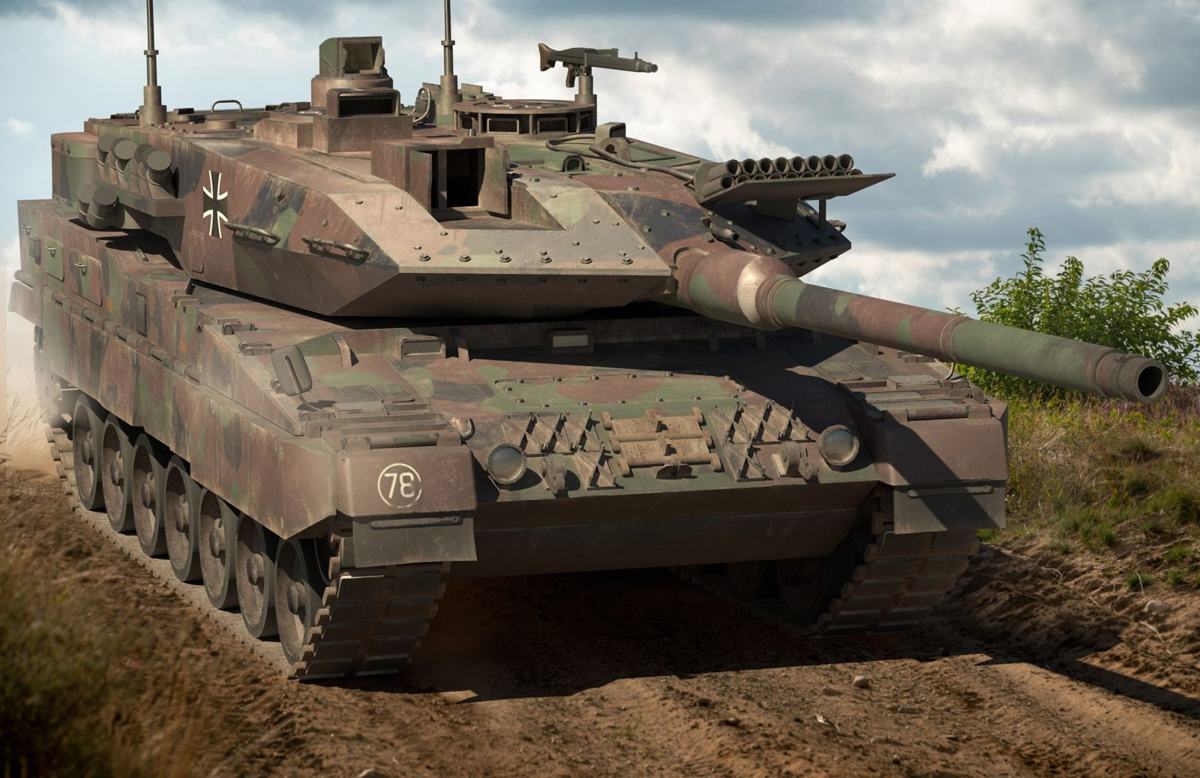
| Leopard 2A7V | M1A2 SEPv3 | |
|---|---|---|
| Country | Germany | United States |
| In service | 1979 (2A7V: 2020) | 1980 (SEPv3: 2020) |
| Weight | 66.5 t | About 66.8 t (73.6 short tons) |
| Main gun | Rh-120 L/55A1, 120 mm | M256, 120 mm L/44 (licence-built Rh-120) |
| Engine | MTU V12 diesel, 1,500 hp | Honeywell AGT1500 gas turbine, 1,500 hp |
| Top speed | About 68–70 km/h | About 67 km/h (42 mph, governed) |
| Road range | About 450–500 km | About 425 km |
| Crew | 4 | 4 |
| Operators | 20+ countries | US, Australia, Egypt, Iraq, Kuwait, Morocco, Poland, Saudi Arabia, Taiwan, Ukraine and others |
Firepower
Both tanks fire 120 mm smoothbore ammunition from guns of the same Rheinmetall design. The Leopard 2A6 and later use the longer L/55 barrel, which gives slightly higher muzzle velocity than the Abrams' L/44. In practice, ammunition type matters as much as barrel length, and the US uses its own depleted-uranium rounds, which Germany does not.
Protection
Both use classified composite armor. US Abrams versions have included depleted-uranium armor layers, while export versions use different packages. Both store most main-gun ammunition in a turret bustle magazine with blow-out panels, so that if the ammunition is hit the blast is vented upward, away from the crew. The Abrams relies on this more completely; older Leopard 2s also keep some rounds in the hull next to the driver.
Engine and logistics
This is the clearest difference. The Abrams' gas turbine is quiet, powerful and accelerates quickly, but it burns far more fuel, especially when idling. The Leopard 2's diesel is more economical, which is a big reason European armies prefer it. Recent Abrams versions added an auxiliary power unit to cut idle fuel use.
Combat record
The Abrams has far more combat experience, from the 1991 Gulf War and the 2003 invasion of Iraq to its use by Iraq, Saudi Arabia and Ukraine. The Leopard 2 has fought in Afghanistan, Syria and Ukraine. Ukraine received 31 M1A1 Abrams from the United States in 2023, and Australia later pledged 49 retired M1A1s. In Ukraine, both tanks have suffered losses to mines, drones and artillery, and both have been fitted with improvised anti-drone screens.
Cost and future
The two tanks are in the same broad price class. Poland's 2022 deal for 250 new Abrams worked out to roughly US$19 million per tank including support; recent Leopard 2A8 deals are about €30–34 million per tank all-in. The US Army has cancelled the planned SEPv4 upgrade in favour of a lighter, more radical M1E3 Abrams, while Germany is moving to the Leopard 2A8 and then the Leopard 3.
Verdict
Neither tank is clearly better. The Abrams has more combat history and a more powerful but thirsty engine; the Leopard 2 is more fuel-efficient, more widely used in Europe, and has a deeper pool of allies sharing parts and upgrades. For a European army, the Leopard 2 is usually the easier fit. For the US and its close partners, the Abrams remains the standard.
Frequently asked questions
Is the Leopard 2 better than the Abrams?
Neither is clearly better. They have similar firepower and protection; the Abrams uses a thirstier gas-turbine engine and has more combat experience, while the Leopard 2 is more fuel-efficient and more widely used in Europe.
Do the Leopard 2 and Abrams use the same gun?
They use 120 mm smoothbore guns of the same Rheinmetall design. The Abrams' M256 is a licence-built version of the L/44; later Leopards use the longer L/55.
Which is heavier, Leopard 2 or Abrams?
The latest versions are similar, around 66–67 tonnes.